Many adult learners have career goals that require additional education or credentials, but they keep putting it off. We understandably hear “"someday I'll go back to school” a lot. And when asked what's stopping them, the answer is almost always finances.
Our education finance coaches have good news, though. After decades of helping other potential adult learners, we know that you might have more of your own financial resources available than you think. But unless you know exactly where your money is going each month, it's impossible to know what you can actually afford or where you might be able to free up cash flow.
That's where a spending plan comes in.
We talked to education finance coaches at EdAssist® by Bright Horizons® about the first step they take when working with adult learners who want to go back to school. Their answer was to create a spending plan. It's a critical first step not only for pursuing continued education or to repay student loans, but for overall financial wellness.
Why it's called a spending plan and not a budget
Real talk: nobody likes the word "budget." It feels restrictive and negative, like you're constantly having to pinch pennies for a lower quality of life.
A spending plan, on the other hand, is about understanding and directing your money. Everybody likes to spend—that's not the problem. The question is whether you're spending intentionally on things that align with your priorities and goals, or if your money is disappearing in ways you haven't even noticed.
This shift in language might seem small, but it matters. A spending plan isn't about deprivation. It's about awareness and intentionality so you can make informed decisions about your money.
Why you need a spending plan
The first step in financial health is understanding what you have coming in and what's going out. Until you have that clarity, it's nearly impossible to make strategic decisions about your finances.
Here's why a spending plan is valuable:
It creates a foundation for financial decisions. Whether you're considering going back to school, paying off your student loans, or just trying to feel less stressed about money, you need to know your baseline. A spending plan gives you that foundation.
It reveals hidden spending. Most people significantly underestimate how much they spend in certain categories. When you actually track your spending for 30 days, you might discover you're spending $400 a month on lunches out, or $200 on subscription services you barely use, or $150 on impulse purchases. Remember, no judgement: this happens to most of us at some point. But you can't make changes if you don't know where your money is going.
It helps you find opportunities. Once you see where you’re actually spending your money now, you can identify areas where you might want to reallocate funds toward your priorities. Maybe your lunch expenses could partially cover tuition for a certificate program, or those unused subscriptions could go toward building an emergency fund.
It shows you what's actually possible. You might think you can't afford to go back to school, but once you see your full financial picture, you may realize you have more flexibility than you thought. That’s especially true when you factor in employer tuition assistance, financial aid, and strategic adjustments to your spending.
How to create your spending plan
Creating a spending plan doesn't have to be complicated. Here's how to get started:
Step 1: Track everything for 30 days
Before you can create a plan, you need to know what's happening now. For the next 30 days, track every single expense. Every coffee, grocery trip, bill, and subscription. Write it all down.
You can use whatever method works for you:
- A simple notebook or spreadsheet
- A notes app on your phone
- Budgeting apps like Mint or YNAB (You Need A Budget)
- Your bank's built-in tracking tools
The method doesn't matter as much as the consistency. The goal is to capture an accurate picture of your spending patterns.
Step 2: Categorize your spending
After 30 days, group your expenses into categories. Common categories include:
- Housing: Rent/mortgage, utilities, insurance, maintenance
- Transportation: Car payment, insurance, gas, public transit, and parking
- Food: Groceries, dining out, coffee, and snacks
- Healthcare: Insurance premiums, copays, medications, and gym membership
- Debt payments: Student loans, credit cards, and personal loans
- Subscriptions and entertainment: Streaming services, memberships, and hobbies
- Personal care: Haircuts, clothing, and toiletries
- Savings and investments: General savings, emergency fund, retirement, and other investments
- Miscellaneous expenses that don’t fit into a standard category
Step 3: Calculate your income
Add up all your income sources for the month:
- Your take-home pay (which what you receive after taxes and deductions)
- Any side income or freelance work
- Other regular income sources, such as child support or alimony
Make sure you're using your actual take-home pay and not your gross salary. What matters here is the money that actually hits your bank account.
Step 4: Compare income to expenses
Now comes the moment of truth. It’s time to compare what's coming in against what's going out.
Are you spending less than you earn? Great. You have some flexibility to work with.
Are you spending more than you earn? If so, you’re not alone. We definitely get it, costs can add up. But this means you're either dipping into savings or accumulating debt, which isn’t sustainable long-term.
You also might be breaking even with little to no wiggle room. You’ll still want to look at either increasing income (which continued education can help with!) or adjusting spending to create some breathing room.
Step 5: Choose a spending plan method
There are several popular methods for organizing your spending plan. Here are a few to consider, but remember the key is to choose the method that feels manageable for you. The best spending plan is the one you'll actually use.
The 50/30/20 rule
This approach divides your after-tax income into three categories:
- 50% for needs: Housing, food, transportation, insurance, and minimum debt payments
- 30% for wants: Dining out, entertainment, hobbies, and non-essential purchases
- 20% for savings and debt repayment beyond minimums
This is a simple starting framework, though it may need adjustment based on your circumstances. If you live in a high-cost-of-living area, for example, your needs might exceed 50%.
Let's say your monthly take-home pay is $4,000. Using the 50/30/20 rule:
- $2,000 would go to needs (rent, utilities, groceries, car payment, insurance, minimum loan payments)
- $1,200 would go to wants (streaming subscriptions, dining out, gym membership, hobbies)
- $800 would go to savings and extra debt payments
Now, what if your current spending doesn't fit this breakdown? Maybe your needs are actually taking up $2,400 a month, your wants are $1,400, and you're only saving $200.
Here's how you might adjust:
- Review your "wants" category for low-hanging fruit. Cancel unused subscriptions ($50/month saved). Cut back on dining out from 12 times a month to 8 times ($120/month saved). That's $170 you've freed up.
- Look at your "needs" for opportunities. Shop around for car insurance and save $40/month. Meal plan to reduce your grocery bill by $60/month. Switch to a cheaper phone plan and save $30/month. That's another $130 freed up.
These adjustments would give you $300 more per month to allocate toward savings or debt repayment, moving you closer to the 20% target.
And remember: the goal isn't perfection, it's progress. Even small shifts in the right direction can make a meaningful difference over time.
Zero-based budgeting
With this method, you assign every dollar a job. Your income minus your expenses should equal zero. This doesn't mean spending everything, but it does mean intentionally allocating money to specific categories, including savings.
Tools like YNAB (You Need A Budget) work with these principles and can help you implement this approach, as you want to “assign” each dollar to a job.
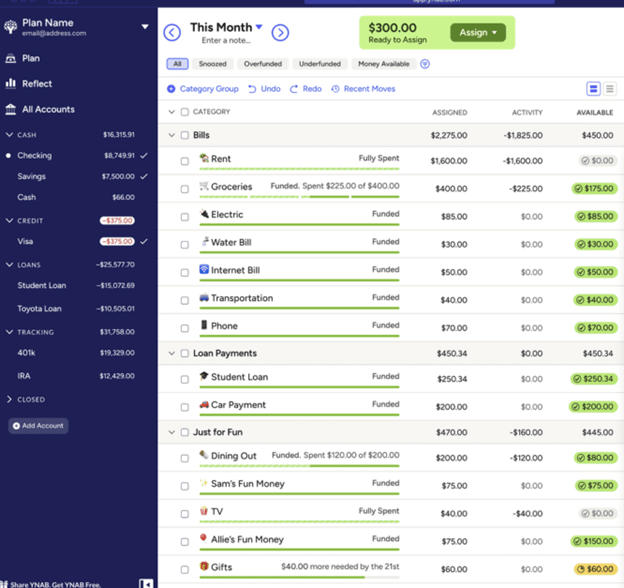
Image source: YNAB
Let's say your monthly take-home pay is $3,500. With zero-based budgeting, you'd assign every dollar:
- Rent: $1,200
- Utilities: $150
- Groceries: $400
- Transportation: $300
- Insurance: $200
- Minimum debt payments: $250
- Emergency fund: $300
- Retirement savings: $200
- Entertainment: $200
- Dining out: $150
- Personal care: $100
- Miscellaneous: $50
Total: $3,500, which equals your income, so you've "zeroed out"
If you get a $200 bonus or side income, you'd immediately assign that $200 a job. Maybe it goes to your emergency fund, extra debt payment, or a specific savings goal.
The envelope method
This old-school approach involves allocating cash to different envelopes for different spending categories. Once an envelope is empty, you're done spending in that category for the month. While most people don't use physical envelopes anymore, you can replicate this digitally with separate accounts or budgeting apps.
Here's what this might look like in practice.
Using the same $3,500 monthly income, you'd create "envelopes" for variable spending categories:
- Groceries envelope: $400
- Gas envelope: $200
- Dining out envelope: $150
- Entertainment envelope: $100
- Personal care envelope: $75
- Clothing envelope: $100
Fixed expenses like rent, insurance, and loan payments are paid automatically, but for these variable categories, you only spend what's in the envelope. If you spend $120 on groceries in the first week, you have $280 left for the rest of the month.
And for those who don’t love the idea of physical envelopes, there is a digital version. Many people use separate checking accounts or apps like Qube Money to create virtual “envelopes.” You move money into each "envelope" at the start of the month and only spend from those designated funds.
Good old pen and paper
Sometimes the simplest approach is the best. A handwritten spending plan in a notebook works just fine if that's what you'll actually stick with. Make sure you include all the essential categories we’ve discussed in this post.
Throughout the month, you write down each expense in the "actual" column. This helps you see in real-time if you're staying on track or if you need to adjust. At the end of the month, you review what happened and plan for the next month.
What to do with the information
Once you have your spending plan in place, here's how to use it.
Identify areas to make changesLook for spending that doesn't align with your priorities. This isn't about cutting out everything you enjoy, but instead comes down to being intentional. If you value your daily coffee, keep , but cancel the subscriptions you don’t use.
Look for opportunities to free up cash flowCan you meal prep instead of eating out as often, or could you negotiate bills like insurance or internet? Maybe you can switch to a more affordable phone plan, or even find a gym that costs $40 a month instead of $100. Small adjustments add up.
Consider ways to increase incomeIf your income is low and there's no wiggle room even after adjusting spending, think about ways to bring in additional money. This could mean asking for a raise, starting a side hustle, or exploring other income opportunities.
Plan for goalsOnce you have a clear picture of your finances, you can start planning for what you actually want to accomplish. If you’re going back to school, build that into your plan. And if you’re building an emergency fund , allocate money toward it. The spending plan becomes a tool to help you reach your goals, not something that feels restrictive.
As a note, our finance coaches always recommend building an emergency fund to prepare for the unexpected if you don’t already have one.
Track regularly and adjust as neededYour spending plan isn't set in stone. Review it monthly and adjust as needed. Life changes, expenses change, and your plan should change with them.
Don't be afraid of what you'll find when assessing your spending
One of the biggest barriers to creating a spending plan is fear. People avoid looking at their finances because they're afraid of what they'll discover.
Whatever is happening with your money is already happening, whether you're looking at it or not. Creating a spending plan doesn't create problems; it just reveals them so you can actually address them.
And often, what you'll find is better than you expected. You might discover you have more flexibility than you thought, or that a few small changes could free up significant resources. And in our experience, it’s not uncommon to realize that going back to school is more feasible than you imagined.
The only way to know for sure is to look.
Ready to take control of your finances?
If your employer offers financial coaching services through EdAssist, you can schedule a free consultation to talk about creating a spending plan, understanding your education benefits, and identifying resources that can help you reach your goals.
Many adult learners are surprised to discover that with employer tuition assistance, financial aid, and strategic financial planning, continued education is more accessible than they realized.
Log into your EdAssist portal to explore your benefits and schedule a coaching session. Let's make "someday" today.