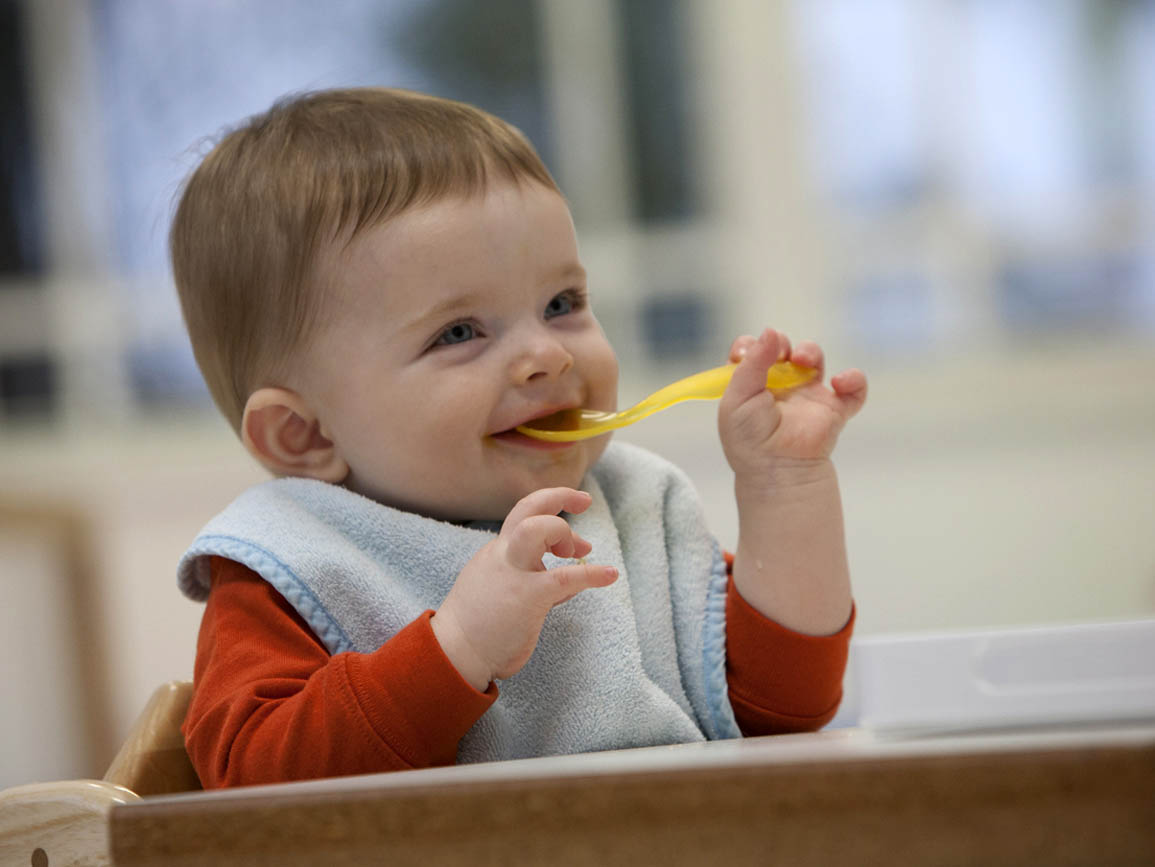
In many early childhood classrooms you will often see meals served "family style." Children and teachers sit together at tables, serve themselves from child-size platters, pour drinks from small pitchers, and share thoughts and experiences as they eat.
When spills and splatters occur, children (with teachers' guidance) wipe them up. Before the meal, children help set the table and afterwards, clean their own area. Parents sometimes wonder, "What's the magic? Why does my child eat at the table so calmly in school, but at home I have to cajole her to just sit down and then beg her to eat her food?"
There is no "magic" but child-centered mealtimes promote so many aspects of whole-child development. Typically, the atmosphere is calm and promotes unity. Self-service fosters independence and empowers children to feel in control of their choices, follow their own hunger cues, and learn to recognize and act on their feelings of hunger and fullness. Teachers and children encourage one another to try different foods.
How child development improves with child-centered meals
- Children learn cooperation and social skills as they practice patience by sharing, passing platters, taking turns, waiting, and using appropriate language and manners.
- It helps develop language, communication, and social skills as they engage in teacher or other student-inspired conversations, share the best and worst part of their day, play word games, make up stories, or discuss current events relevant to their age group.
- Child-centered meals expands fine motor skills as children serve themselves, learn to hold flatware, and pour their own beverages.
- Children learn mathematical skills, including spatial relationships and one-to-one correspondence, e.g., sorting and counting the flatware, setting the table, or placing the chairs. language along with spoken words. Use mathematical words while dining such as “more,” “small,” “big,” “full,” and “empty.”
- Dining together deepens relationships and friendships in a relaxed atmosphere where children can focus on one another without outside distractions.
After visiting a classroom, parents might wonder how child-centered mealtimes can happen at home. Here are a few family meal tips from child care centers and preschools that you can do at home to help with your child's development:
- Resist the temptation to pre-fill your child's plate.
- Instead, try some child-sized bowls, serving utensils or pitchers. Children can use plastic tongs or a large spoon to serve food and transparent, plastic cups or pitchers with a spout to pour their beverage.
- Encourage everyone to sit down together and one-at-a-time share something good about their day.
In reality, we're replicating what many families already do. Think about enlisting your child's help to prepare a meal, dine together, and clean up afterwards. These family meals will become valuable opportunities for connection, relaxation, and enjoyment.